
The Big Offsetting Lie.
Monoculture Carbon Plantations and COP30.

What is a forest?
A collection of trees and shrubs, bound by wooden limbs, twisting and stretching beneath the ground. A forest flickers with life, new and old. A refuge for the human, a home for the non-human. The dirt is not dirt at all. It is a communication system, centuries old, deep and rich with secrets. Death and decay breed new life to the earth. A forest community whispers alerts and signals through mycelium threads - a web of intricate mycorrhizal (fungal) networks in the ground beneath your toes.
What is a replanted forest?
A simulacrum. A stand-in. An expensive and well-intentioned fiction that we’ve mistaken for a solution.

The Offset Illusion
For decades, carbon offsetting has offered a comfortable narrative: continue burning fossil fuels, but plant trees to balance the scales. The math seemed clean. The solution seemed scalable. And crucially, it required no fundamental change to how we extract energy or organise economies.
This week in Belém, Brazil’s leading climate scientists, assembled as the COP30 Science Council, put quite frankly: forests cannot be used as offsets. It is not scientifically viable to offset permanent fossil fuel emissions with nonpermanent, vulnerable biological carbon. This is especially true for Amazon - an ecosystem approaching a tipping point. Soil wrecked from drought, fires, farming and heat waves is turning the region from carbon sink to carbon source. Forests - especially the Amazon - can no longer be treated as stable carbon sinks capable of compensating for continued burning of coal, oil and gas.
Indigenous delegates, activists, and local communities gathered in Belém echoed this warning. “This is the Amazon COP,” one op-ed argued. “If it ends with a decision that ignores Indigenous rights and props up offset markets that science says cannot work, it will squander the moral clarity of this moment.”
The Problem With Permanence
When you burn a fossil fuel, that carbon enters the atmosphere permanently (on human timescales). The only way to truly offset it is to permanently remove carbon from the atmosphere. But a replanted forest? A monoculture plantation? These are temporary at best. They can burn. They can be clearcut. They can be logged. They can succumb to drought or disease. They can be converted to agriculture. They offer no guarantee of permanence.
And yet, offset markets have treated them as equivalent. This is not a technical problem waiting for better accounting. This is a structural failure in how we’ve chosen to think about climate responsibility.
Monoculture vs. Biodiversity
The problem deepens when we examine what actually gets planted in offset projects. Large-scale monoculture forests. Rows of a single species, often non-native trees optimised for rapid growth and timber extraction dominate offset schemes. They are cheap to establish and they grow quickly. On spreadsheets, they appear to sequester carbon. Compared to a centres old, naturally occurring mixed species forest, they are ecological deserts.
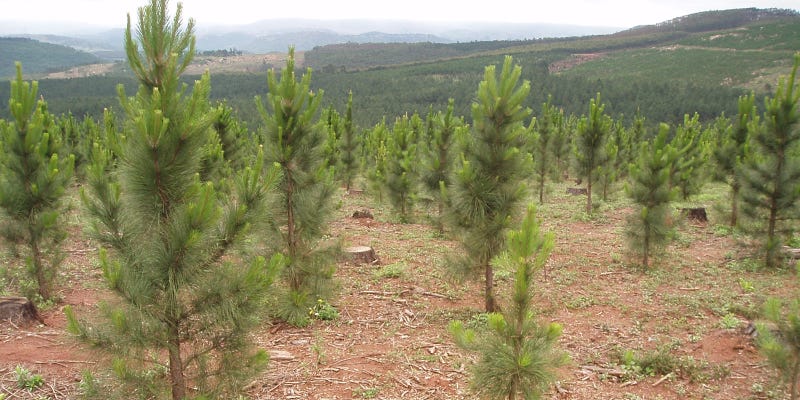
This matters for carbon storage itself. Old-growth forests store carbon not just in living wood but throughout entire ecosystems- in soil, in the understory, in the complex web of decomposition and regrowth. A monoculture stores carbon in timber, which is then harvested. When you cut the tree, the offset evaporates.
More fundamentally, it matters for resilience. As the Amazon approaches fragility, as heat and drought stress increase, which forests will survive? The diverse, interconnected systems that have evolved over centuries to weather ecological shocks? Or rows of a single species, designed for extraction, dependent on consistent conditions that the climate crisis is actively destroying?
The answer is obvious. And yet offset projects continue to treat these as equivalent solutions.
Where do we go from here
The risks and failures of carbon offsetting have been dismissed for years as activist exaggeration or technical problems waiting for solutions. The question now is whether this truth will translate into action. Will COP30 move forward on climate finance that prioritises emissions reduction over accounting tricks? Will it recognize Indigenous rights and land stewardship as central to forest protection, rather than as obstacles to offset schemes? Will it acknowledge that you cannot trade your way out of the climate crisis? Or will the offset machinery grind on, now armed with slightly better language, slightly better science-washing, still fundamentally unchanged?
The alternative to offset logic is not complicated. Protect existing forests. Especially old-growth forests which have proven far more resilient and biodiverse than any replanted alternative. If reforestation happens, do it in service of ecological restoration, not carbon accounting. Invest in Indigenous land rights, which are among the most effective forest protection mechanisms we have. Support climate finance that flows to communities on the frontlines of climate impact, not to corporations seeking to offset their emissions. The forests are not offsets. They are the planet’s life-support system and we are running out of time to treat them accordingly.
Great piece Skylar. I totally agree, forests aren’t accounting tools, and monoculture offsets will never replace old-growth ecosystems or Indigenous stewardship.
Working in nature recovery, I see the same pattern in the UK but there are some great schemes out there too.
I also think there is potential in carbon finance when it’s used carefully, not as an excuse to keep emitting, but to support real ecological restoration, long-term stewardship, and community-led land governance. I’ve seen good examples of this (look up trees for climate and community forests) so know it can work.
The shift we need is from offsets-as-loopholes to finance that actually serves nature and people. Forests aren’t a workaround. They’re a living system, and we have to treat them that way. 🌳
Well said!
The only somehow positive that I see out of this is that natural parks and trusts can get some much needed money from the companies that choose to offset their emissions.
But other than that, the concept makes no sense.